
How BACnet Integration Unlocks the Full Value of Lighting Controls
Lighting Is No Longer Just a Utility
For decades, lighting systems have been treated as standalone infrastructure—designed primarily for illumination, with energy efficiency added later as a secondary consideration. In parallel, building management systems (BMS) have evolved independently, overseeing HVAC, scheduling, and mechanical operations based on assumptions about occupancy and usage rather than real-time conditions.
This separation has created a persistent inefficiency in building operations. Lighting systems often have the most accurate, real-time understanding of how spaces are being used, while the systems responsible for comfort, energy, and performance operate without that insight. The result is buildings that respond slowly and lack coordination across core systems.
That model is now beginning to shift.
The Untapped Intelligence Inside Lighting Systems
Modern networked lighting controls do far more than manage illumination. Systems built on Bluetooth® Networked Lighting Controls (NLC) continuously generate real operational intelligence about the built environment, including occupancy activity, ambient light conditions, energy usage patterns, and device health diagnostics.
Among these, occupancy data is particularly significant. It provides a direct, real-time view of how spaces are actually being used throughout the day—something few other building systems can accurately capture. Yet in most facilities, this information remains confined within the lighting network and is not available to other systems that could act on it.
Breaking Down System Silos
Even in highly advanced buildings, lighting and building management systems frequently operate in isolation. Lighting may know exactly when and where spaces are occupied, while HVAC systems continue to run based on static schedules. Facility teams may have access to multiple dashboards, but not a unified view that connects building performance across systems.
This lack of integration leads to decisions made with incomplete context and missed opportunities for coordination between systems that are, in reality, observing the same building from different perspectives.
Creating a Connected Building Ecosystem
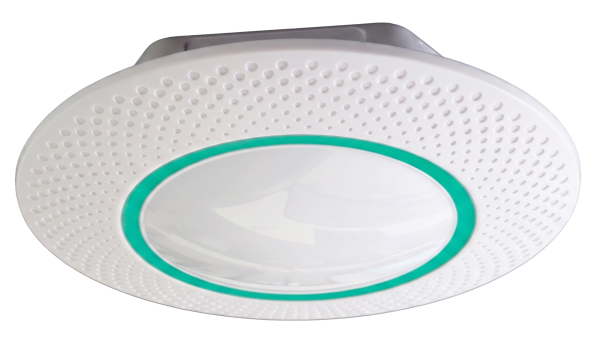
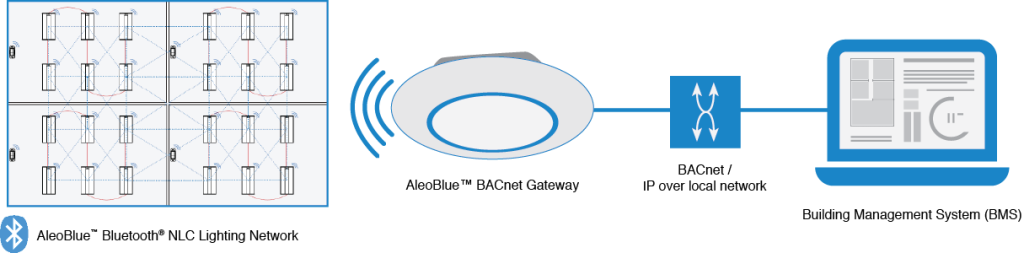
The AleoBlue™ BACnet Gateway bridges this gap by connecting Bluetooth® NLC lighting networks with BACnet/IP-based building management systems. It translates lighting system data into standardized BACnet objects, allowing it to be used directly within existing BMS platforms without custom development or proprietary interfaces.
The integration is deployed on-premise and operates securely without reliance on cloud connectivity. Using BACnet Change of Value (COV) messaging, the system transmits only meaningful updates, enabling efficient, real-time communication between lighting and building systems.
Turning Data Into Action
Once connected, lighting data becomes structured, zone-based intelligence within the building management system. This includes:
- Real-time occupancy information by zone
- Ambient light levels across spaces
- Energy usage and consumption trends
- Lighting state, dimming levels, and control status
- Device health and system diagnostics
Rather than presenting raw device-level data, the information is organized in a way that aligns with how buildings are actually designed and operated. This makes it immediately usable within existing workflows and control strategies.
With this level of visibility, buildings begin to shift from static operation to dynamic response. HVAC systems can adjust based on real occupancy rather than schedules, lighting scenes can be coordinated through building-wide logic, and facility teams gain a clearer understanding of how spaces are performing in real time.
Built for Real-World Integration
The AleoBlue BACnet Gateway is designed to fit into existing building environments without requiring major changes to infrastructure or workflows. It supports up to 100 zones and approximately 200 devices per gateway, providing scalability for a wide range of commercial applications.
Additional capabilities include:
- Standard BACnet object mapping for seamless compatibility
- BACnet write functionality for control actions such as scene recall and dimming adjustments
- Zone-based architecture aligned with real-world space design
Rethinking the Role of Lighting
As building systems become more connected, lighting is beginning to take on a fundamentally different role. It is no longer just a utility responsible for illumination, but part of a distributed sensing and intelligence layer within the building.
In this context, lighting becomes a source of real-time operational insight, a contributor to energy optimization, and a bridge between physical space and digital building systems.
The Foundation for Smarter Buildings
The evolution toward intelligent buildings does not necessarily require entirely new infrastructure. In many cases, the systems already exist—they simply need to be connected in a meaningful way.
By unlocking lighting data and integrating it into building management systems, organizations gain a more complete understanding of how their buildings operate. The result is improved coordination, better decision-making, and environments that respond more effectively to real-world conditions.
The AleoBlue BACnet Gateway turns lighting into a foundational layer of building intelligence—helping transform static facilities into connected, responsive, and adaptive environments.